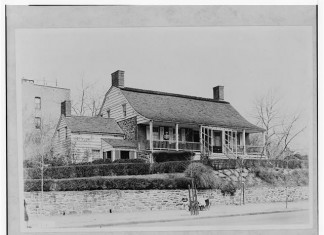
New York Sun, November 5, 1938.

In early November of 1938 newspapers around the globe trained their headlines on a stunning victory on the Pimlico Race Course in Baltimore, Maryland.

The heroic story of Seabiscuit, a small, knobby-kneed horse who preferred sleeping to racing, over War Admiral, the four to one favorite, captured everyone’s imagination.

The underdog had slain Goliath and stoked the hopes and dreams of a nation emerging from the Great Depression.

Amid the backdrop of this inspirational tale, New York Sun reporter Gerry Fitch was given the rather tedious assignment of documenting the impending demolition of a once splendid mansion on the northern tip of Manhattan.

New York Sun, November 5, 1938.

The mansion in question, the old Seaman-Drake estate, was nearly a hundred years old and Fitch would soon become well versed, and possibly even enchanted, by its rich, romantic history.

Inwood’s Seaman Mansion in 1892, photo by Ed Wenzel. (Click on photo to enlarge)

Fitch soon realized he too was witnessing an historic moment.  But in his story, the beloved underdog, once dubbed the “Mount Olympus of northern Manhattan,” hadn’t a chance.   A scarcity of real estate combined with a local building boom rendered the once fantastic home obsolete.  The home would soon be razed in order to make room for a five-building housing development to be named Park Terrace Gardens.

A magnificent stable a block away, once also owned by the Seaman family would also be demolished to make room for even more apartment houses.

Seaman Mansion in grander days.

When Fitch visited the home in 1938 the old mansion was truly a shell of its former self.  The statuary, the gleaming white marble, even the stunning cupolas that could once be seen from miles away, had long since been stripped away.

Seaman Mansion ready for demolition in mid-1930′s.

Only one section of the home was still inhabitable.  In that wing lived builder and architect Thomas Dwyer, who had purchased the home from Seaman descendant Lawrence Drake in 1906.

Thomas Dwyer advertisement, New York Society of Architects, 1920.

Dwyer ran his business, The Marble Arch Corporation, from the attic of the arch, which graced the Broadway entrance to the property.  Dwyer, an architect of some note, was well known for his work on municipal projects, monuments and museums around the metropolis.  His Soldiers’ and Sailors’ monument on Riverside Drive remains, even today, part of Manhattan’s urban landscape.

Aquarium in Castle Garden (also called Castle Clinton), 1893, Source: Corbis.

His more fanciful designs included the aquarium inside New York’s former Castle Garden and marble detail work for the Metropolitan Museum of Art.

During discussions with Dwyer, reporter Gerry Fitch learned the history of the grand old marble mansion as well as the former stable that was also slated for demolition.

Dwyer was obviously distraught to see his former home taken apart by the wrecker’s ball, but was a builder and a pragmatist.

Standing there, on that November day, Dwyer and Fitch realized the import of what was soon to transpire.  This was the twilight of the old neighborhood, that fleeting moment in history where the knobby-kneed neighborhood favorite is finally defeated by the march of time.

Before: Seaman Mansion seen in 1937 aerial.

After: 1939 aerial shot of Park Terrace Gardens, New York Times, August 13, 1939.

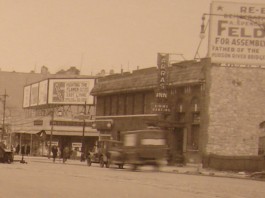
Amazingly, the marble arch, from where Dwyer designed forgotten landmarks of old New York, survived.   The arch, its walls supported by low-slung garages on either side, can be seen today on the west side of Broadway at 216th Street.

Below is Fitch’s article describing the last days of the old house on the hill.

New York Sun
November 5, 1938
Last Days of Old Mansion
Dwyer House in Inwood Will Soon Give Way to Modern Apartment Buildings
By Gerry Fitch

Inwood is high and handsome and has become so popular that even the many new apartment buildings cannot satisfy all the Manhattanites who have re-discovered this northerly end of the city.  So it is welcome news that a group of five new eight-story apartments, built around large gardens, will shortly be erected on one of Inwood’s highest points, to be ready for occupancy next summer.

Seaman Mansion for sale, New York Times February 2, 1913.

The 118,000 square feet of property to be thus occupied is the tract bounded by Park Terrace West and Park Terrace East, 215th to 217th Street.  It is a desolate surface of exposed rock and corroded earth, topped by a gloomy mansion that has made many a passing motorist gaze up toward it as though it might have been a setting for a Bronte novel.  It is of gray stone, with a high square tower, and it stands skeleton-like, windows gaping, stone parapets broken, commanding a view over the Hudson, Harlem and East rivers.

Seaman mansion and arch from a distance in 1903.

This house is known as the Dwyer house. Its present owner, Thomas Dwyer, who was a prominent contractor, has lived in it nearly thirty years; when he bought it long ago it was already fifty years old.  If you climb up to the house you will notice that while most of it could correctly be called a ruin, there is one section that is in neat repair, its bright and curtained windows affording strange contrast to other broken windows made steadily worse by the rocks of passing schoolboys.  This conditioned section is the one Mr. Dwyer has made his own in recent years, hating to leave until, as his “For Sale” sign on the property sets forth, he could find a “perfectly responsible party” with whom he “might take an interest in the improvement of the property.”

Park Terrace Gardens apartment advertisement, August 31, 1939, New York Times.

Such a party was found this week.  In one of the largest sales of vacant Manhattan real estate closed in several years, the Thomas Dwyer family sold the property through Jacob and Emil Leitner, brokers, to a corporation headed by David Rose.  The corporation’s plans for development of the site call for more than two acres of landscaped gardens, the five fireproof buildings occupying a comparatively small portion of land.

A Former Showplace

Each structure—they have been designed by Architect Albert Goldhammer—will contain eighty apartments with suites of three, four and five rooms.  Rentals have not been set, but rentals for attractive suites in the Inwood section are around $75 a month for three and four rooms.

Down will come the Dwyer mansion before many weeks.  Thomas Dwyer will move not far away, however—just down the street known as park Terrace East to an apartment at No. 10.  And when the new buildings are up he can move back to the very plot he has kept for so long.  He hates to see the house come down; he can remember when it was a showplace of northern Manhattan.

Seaman Drake Arch captured in 1911 postcard.

You arrived at the estate and were confronted by an imposing stone arch.  You drove under this and then round and round the grounds in spiral ascendance until you arrived at the great stone steps.  There was an impressive entrance and much outside statuary. Inside were large rooms, with ceilings fifteen feet high; wall niches with more statuary, grand stairways and mantelpieces, conservatories, balconies.

Marble arch in 1929.

It all remains in altered form.  Jammed up against the stone entrance arch—it looks about the size of the one in Washington Square and faces Broadway at 116thStreet—are now small shops that hide all but the top of the arch.

Seaman Mansion in September, 1937, MCNY.

The grounds have been so dug out in places that they look like a series of trenches surmounted by a sort of old gray army tank that is the towered house.

Mr. Dwyer added a third story of ten rooms, and the tower thirty years ago, but has always been sorry he did.  During late years a number of visitors, failing to observe the lived-in section and thinking the place abandoned, have climbed the stone steps to the entrance and jangled the bell, just to see if it would ring.  That’s what I did, and, believe me, the bell rings.  It is something of a shock to have the door suddenly open and a young man in a bathrobe, obviously disturbed, trying very hard to be polite over the intrusion.  No wonder the Dwyer family is reconciled to moving.

Near Two Subways

The neighborhood is now quickly reached by both the Eighth Avenue and Seventh Avenue subways.  On a nearby height to the south stands the tower of Mr. Rockefeller’s medieval cloisters.  To the north is Baker Field.  Historic Dyckman farmhouse is a few blocks away.  Spuyten Duyvil Creek flows into the Hudson just beyond.  All around are charming English-type one-family brick cottages and new apartment houses, “modernistic” or Colonial in design.

{ 6 comments }

Much of what we know today about the history and pre-history of Inwood and Washington Heights is due largely to the turn of the century work of amateur historians, self taught archaeologists and close friends William Calver and Reginald Bolton. Starting in the 1880′s Bolton and Calver began exploring northern Manhattan with picks and shovels, chronicling their discoveries along the way.

An Inwood dig site near the turn of the century. Reginald Bolton (left, sitting) and William Calver, standing to right of dig site.

An Inwood dig site near the turn of the century. Reginald Bolton (left, sitting) and William Calver, standing to right of dig site.

What you are about to read is an essay written by William Calver in 1932 describing those early days before the urbanization of Northern Manhattan. The original draft, written in fading pencil on lined legal paper, is housed in the Archives of the New York Historical Society.

Recollections of Northern Manhattan
W.L. Calver
3-10-1932

Back in the early 1880′s when the writer first became familiar with that section of Manhattan Island known as “Inwood” it was only a fairly good class of humor when a reporter for one of the city newspapers alleged that in the course of a visit to northern Manhattan he had conversed with a farmer who declared that he had not been down to New York for the past twenty five years. The agriculturalist had been promising himself, however that he would be making a pilgrimage that way before long for he had heard that great changes had taken place to the Southwest and Yorkville had gotten to be as big as Harlem. Our own experience with Inwood in these far off days led us to believe that the scribe’s story might be at least-plausible.

Turn of the century postcard depicting Veitch's grocery on Dyckman just west of Broadway. Note the card reads "Tubby Hook" rather than "Inwood."

Turn of the century postcard depicting Veitch’s grocery on Dyckman just west of Broadway. Note the card reads “Tubby Hook” rather than “Inwood.”

The very name “Inwood” as applied to the locality in question was suggested by its ultra-rural character, and we ourselves got it from a venerable clerk of one of our courts that he in turn thus sponsoring the locality, on the occasion of his surrendering his trust for certain properties thereabouts in the 60′s, had good reasons for his choice of such a name. To nature lovers the name was attractive, but with the ultimate expansion of the City the appellation of “In-wood” was anathema to the promoters of real estate, tough prospective buyers went further and fared worse.

View of the Kingsbridge Road, Valentine's Manual, 1866.

View of the Kingsbridge Road, Valentine’s Manual, 1866.

While dealing with names we would say that in Revolutionary days all of the northern end of the island was known as “Kingsbridge,” as in our day the settlement contiguous to the old bridge-on its northerly side-is so called. Previous to the adoption of the present name of “Inwood” the locality bordering on the present day Dyckman Street-west of Broadway, was called “Tubby Hook.”
[click to continue…]

{ 0 comments }

The Old Nagle Cemetery

Inwood Cemetery, NYC

In mid-17th century Jan Nagle and Jan Dyckman traveled to the New World and settled in northern Manhattan. For more than two centuries the families farmed the land, raised cattle, planted orchards, built bridges and homes and even intermarried. And while Dyckman is a familiar Inwood name, largely thanks to the preservation of the post-Revolutionary [...]

Read the full article →

Inwood’s Indian Life Reservation

Thumbnail image for Inwood’s Indian Life Reservation

In the winter of 1926 Inwood historian and local archeologist Reginald Pelham Bolton began work on a curious and eclectic exercise, the creation of an Indian reservation in Inwood Hill Park.   Bolton’s vision was not to be a true reservation, but rather a recreation of what a Native American encampment might have looked like. “The [...]

Read the full article →

Fort George Amusement Park

Fort George Amusement Park in turn of the century Inwood, New York City

“Harlem’s Coney Island has one great advantage over Everybody’s Coney Island, and that is it costs only a nickel to get there. Every nickel means a glass of beer or a frankfurter, and every East Sider knows the value of a nickel. That is one great reason why Fort George is popular.” -The Sun, August [...]

Read the full article →

Spuyten Duyvil Poem

Spuyten Duyvil Ernest Lawson Inwood New York

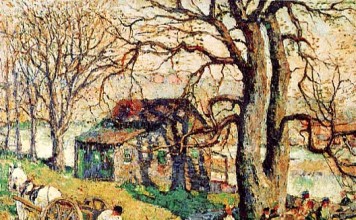
Fishing thorough old newspapers I recently came acrosss a beautiful poem published by the New York Sun in 1910. The work, titled “Spuyten Duyvil on the Crick,” was penned by Irish-American poet Eugene Geary. I’ve paired Geary’s poem with another 1910 work by impressionist painter Ernest Lawson, who, like so many other artists, found himself [...]

Read the full article →

Inwood Featured in 1968 Documentary: “Goodbye to Glocamorra”

Goodbye to Glocamorra

“Goodbye to Glocamorra,” examines the role of the Catholic Church, namely Good Shepherd, as the neighborhood begins its transition. The film was produced by Radharc and aired on Irish television.

Read the full article →

1921: Inwood Teens Make Girl Scout History

Inwood New York City Girl Scouts

On a March morning in 1921 two Inwood teens, Gertrude Nathan and Beatrice Cline, boarded the subway at 207th Street for one of the most memorable rides of their lives. The girls were heading downtown on a very special mission on behalf of the Girl Scouts of America. The organization’s national director, Jane D. Rippin, [...]

Read the full article →