
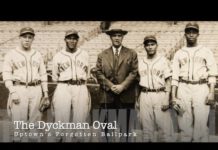
The year was 1935. Babe Ruth, the Bambino, was reveling in the twilight of his fame. The Sultan of Swat, the King of Swing, the Colossus Of Crash had seen better days. Years of hard living and several automobile accidents had taken their toll, but the Babe could still draw a crowd—and the racially diverse spectators at the Dyckman Oval were his kind of people.
On September 29, 1935 they came in droves.

That sunny afternoon an estimated 10,000 fans came to the 4,600 seat Dyckman Oval to see their hero play on a team of former all stars and minor leaguers in an exhibition game against the New York Cubans of the old Negro League. The price: Fifty-five cents for the grandstands and $1.10 for the big spenders in the box seats.
The game, for which Ruth was paid three thousand dollars, would be one of his last.
Amid the sea of fans, one lone reporter, Tom Meany of the New York Telegram, realized the tragedy unfolding before his very eyes.
 “The spectators seemed to sense they were watching something pathetic…There were neither newsreel nor still cameras in evidence and no telegraph keys clattered brassily in the press box, which had less than half a dozen occupants. No civic dignitaries, not even an alderman, could be observed in the crowd.”
Paid to play just the first game of a double-header, which the Cubans won 6 to 1, Ruth took to the plate between games to give the ticket holders a bit more bang for their buck. Over the next five minutes, Meany and the 10,000 fans witnessed a piece of baseball history that would never be entered into the record books.
As pitcher Clyde Barfoot hurled balls from the mound, The Babe, for a fleeting moment, sprung back to life, slamming ball after ball out of the park. Those in attendance swore one particular baseball was hit further than any in the previous history of the Dyckman Oval.
But as Ruth faded into the stuff of legend, the Dyckman Oval was entering its heyday…


When the Dyckman Oval first appeared in the sports pages in January of 1920 it was a homely affair located at 204th Street and Nagle Avenue. That first year the Oval was used primarily for ice skating competitions.

 By 1921, the Oval was drawing baseball fans, including Mayor John F. Hylan, from all five boroughs and beyond.
That spring Hylan made an impromptu visit to the Oval to see Jeff Tesreau’s team battle the Cuban Stars. Not recognizing the Mayor as he approached, a later shame-faced gateman demanded to see a ticket. “I haven’t any,” responded the mayor. Gateman, “Well, you’d better get one if you want to see this game.”
Luckily for both parties a manager spotted the Mayor and escorted him into the Oval where he immediately took to the mound.

The mayor threw four pitches against the opposing team—three of them strikes.
Soon boxing was added to the roster. Pugilism would become a staple of the Oval for years to come, but at the time, many doubted the Dyckman Oval could survive the 1920’s.

By 1929 the Dyckman Oval played host to mainly soccer games. Lawsuits and years of poor management had left the once thriving facility on life support.

It was not until 1935, the same year Ruth played his exhibition game that things turned around for the Dyckman Oval, but first a deal with the devil had to be made.
 Enter Harlem numbers broker Alejandro Pompez who gave the ailing Dyckman Oval a sixty-thousand dollar shot in the arm to use as a showcase for his prized baseball team, The New York Cubans.
A 2003 Sports Illustrated article written by Daniel Coyle provides a wonderful description of Pompez.
“Pompez was a criminal in the eyes of the police and a crown prince in the eyes of Harlemites. From his cigar store, the soft spoken Cuban ran a numbers bank—a lottery that filled his pockets to the tune of $8,000 a day—which he used to fund his Negro league baseball team, the New York Cubans. Courtly, suave and scrupulously honest with his clients, Pompez was beloved in Harlem for his civic generosity.
 All went swimmingly for him until an evening in 1931 when the Bronx-based gangster Arthur Flegenheimer, better known as Dutch Schultz, employed his .45 revolver to persuade Pompez to hand over control of the numbers game. Needing another source of income, Pompez turned to sports enterprises. In 1935 he leased a vacant field at Dyckman Oval from the city and transformed it into one of the finest sports palaces in Manhattan.”
Pompez put his money to good use. Under his renovations the Dyckman Oval was transformed into shining new 10,000 seat arena with modern conveniences like floodlights for playing well into the night.
A master showman, Pompez knew how to fill the house. If Babe Ruth didn’t dazzle them then perhaps a boxing exhibition with Joe Louis, a new car raffle—whatever it took.

The Oval, often called “Harlem’s Own,” was also a melting pot where all New Yorkers could gather and simply enjoy a ball game—and Pompez’s New York Cubans knew how to delight.
 Player-manager Martin Dihigo was clearly a house favorite. Dubbed “El Maestro” by fans and sportswriters alike, Dihigo could play all nine positions with equal skill. His lightening speed fastballs remain the stuff of legend. Often called the most versatile player in the history of baseball, the six-foot-three, 210 pound, right-handed Cuban would eventually be elected to the Mexican, Cuban and American Halls of Fame.
The entire team, comprised of Cuban, African-American, Puerto Rican and Dominican players proved a force to be reckoned with—even when playing against legendary teams like Satchel Paige and his Pittsburgh Crawfords.
But the days of wine and roses couldn’t last forever—the team’s owner, Alex Pompez, was, after all, a career criminal. When rival gangsters gunned down Dutch Schultz in October of 1935, Pompez went back into the numbers rackets.
The move would prove a serious miscalculation.
In 1936 New York County District Attorney Thomas Dewey was preparing an indictment against Pompez for his involvement in the policy rackets. Receiving a tip, Pompez fled the country.
When Mexican authorities arrested Pompez on March 28, 1937 he was traveling under the name Antonio Moreno. Federales in Mexico City nabbed baseball’s greatest fugitive as he stepped into a bulletproof car with Chicago license plates.
 Pompez’ legal difficulties would prove disastrous for his beloved franchise. While the Dyckman Oval would continue to host sporting events, the New York Cubans stopped playing altogether.
On May 16, 1939, after providing lengthy testimony for the prosecution, Pompez pleaded guilty to conspiracy in return for a two year suspended sentence.
When the Cubans were readmitted to the Negro National League in 1939 they would find themselves without a home.
In 1938, perhaps to spite the admitted gangster, the City of New York demolished the Dyckman Oval and turned the grand old field into a parking lot.

Today the Dyckman Houses sit on this once hallowed sporting ground.
 As for Pompez—he swore to stay on the straight and narrow after his trial. By all accounts he did just that.
In 1943 Pompez found a new home for the Cubans inside New York’s famed Polo Grounds.
Lacking fan support, the New York Cubans folded in 1950.
Pompez went on to become a respected talent scout who once played a role in signing Willie Mays.
Credited with opening baseball’s “Dominican Pipeline,”
 Pompez died in 1974. He was 83-years-old. Pompez was elected to the National Baseball Hall of Fame in 2006.




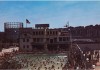

Cole: Interesting and more information than I’ve read, as usual. I particularly liked the next to last picture of the Dyckman Houses. It took a few minutes to orient myself, but with the “Speedway” in the foreground, one can see, among other things, the lot along Nagle Ave. that was full of white rocks (Inwood marble?) until the 60s, I think, when a large building went in. Also interesting to see the projects in their infancy with those tiny little trees.
By the way, a probably little known fact, and I wonder how many old-timers like myself would remember this…when I was a very young child, maybe 6 or 7, there was a pony-ride facility on the Speedway south of the projects. It was just a little ring, and I have no idea how long it lasted. It was probably 1951-52.
Betty,
As usual, thanks for writing in. I like that photo of the Dyckman Houses as well. It looks more like a model than the real thing. Cole
Cole: Interesting and more information than I’ve read, as usual. I particularly liked the next to last picture of the Dyckman Houses. It took a few minutes to orient myself, but with the “Speedway” in the foreground, one can see, among other things, the lot along Nagle Ave. that was full of white rocks (Inwood marble?) until the 60s, I think, when a large building went in. Also interesting to see the projects in their infancy with those tiny little trees.
By the way, a probably little known fact, and I wonder how many old-timers like myself would remember this…when I was a very young child, maybe 6 or 7, there was a pony-ride facility on the Speedway south of the projects. It was just a little ring, and I have no idea how long it lasted. It was probably 1951-52.
“there was a pony-ride facility on the Speedway south of the projects. It was just a little ring, and I have no idea how long it lasted. It was probably 1951-52.”
I remember it!
I remember playing on those white rocks, too.
I grew up in the Dyckman Houses (213 Nagle) and played on those white rocks (Inwood marble) until they constructed 240 Nagle Ave., circa 1967. There was a small outcrop remaining on Nagle, between 204 & Academy for at least 20 years, where a parking lot stood. When I visited in the early 2000s there was a building sitting in that former lot.
That “pony”ride was owned by a good freind of my family,Charlie Street,I use to work there after school and on Saturdays.They weren’t ponys they were full grown horses,I oughta know,I cleaned the stables and also was allowed to ride as often as I wanted as long as we weren’t busy,sometimes right to my house at 120 Vermilyea.
Jim
Yes, they were horses! I was 3 years old, they strapped me onto the saddle and the horse took off with me at a gallop. I think we jumped a fence. It was terrifying!
I lived near Nagle and 204th in the fifties and sixties and we played on the White Rocks all the time. I never knew the history of the Dyckman Houses land area until now. Thanks Cole, for some memories I never had until now.
Cole,
I’ve read and enjoyed just about every piece on your website. I have been on the Inwood boards for years and am a big fan of both Inwood and NYC history. Your website, research and findings are top notch. Special kudos to the Dyckman Oval piece (born and raised at 204 and Post) and the Inwood Pottery piece ( I own a couple of non museum quality pieces). I wish I still had the stuff I dug up near the caves in the park in the late 60’s early 70’s as it was fascinating. Many thanks!
I grew up in the Dyckman Houses from 1955 to 1971 and I knew about the Dyckman Oval
which practically went pass my building (7) 3784 Tenth Ave. I believe that was the extension of Academy Street to 10th ave. I love looking at that old photo of the newly built Dyckman Projects and you can see the newly planted trees. We played football, baseball, punch ball all over the projects and on the Big Lawn between building 1 and 2
And we also played on the White Rocks which was a bit high and dangerous. You had to be careful up there. I still visit the projects every so often.
I used to see Sugar Ray Robinson running on the Speedway. His Purple Cadilac not far behind and as far as great boxing at the Dyckman Oval many on the way up &down fought there. Paul ? owned an auto repair shop next to the stables and the old Con ED plant across the small alcove. What I remenber was an old lady who lived on a barge in this Harlem River alcove with a Parrot,the first I ever saw that talked. Fond memories
I was born on 204th St just east of Vermilyea Ave. and left Inwood in Jan. 1943 to join the Navy. I worked in the Consolidated Shipbuilding Yard in 1942, just across the East River from Inwood in what is called Morris Heights. I would walk across the 207th St. bridge, passing the Miramar pool to get to work. Navy PC ships were being built there at the time. What a great neighborhood to grow up in. Thanks for bringing back all those wonderful memories of Inwood on the Hudson.
[…] to myinwood.net/ for all the great historical information and […]
I remember climbing around on those white rocks and caves on Nagle. When I was around 8, my father took me to the Speedway and showed me how to ride a horse. For a quarter I rode the horse 3 times around the ring. Perhaps you remember the day there in 1954 when a whitish horse tried to attack me as I sat on a bench inside the wire fence. I had parked my bike outside and came in to reminisce. I recognized the stable worker mounted on the horse. He was talking with another worker, when the horse began to look at me. At first I thought I imagined it, but the horse kept trying to pull his head around, and I could see the whites of his eyes as he stared at me. Suddenly the horse bolted towards me. The rider pulled on the reins and dug into the stirrups, but couldn’t stop the horse. When the horse rose up on his back legs in front of me, I darted under his belly and got behind a tree. Everyone was staring in silence, but then broke out laughing when they saw me peering from behind the tree. I looked around the tree and saw the horse’s front feet on the back of the bench, where I was sitting, with the rider trying to back him down off the bench. I left the minute I could. This was a very unusual event, and I have never solved why that horse did what he did. If you were there and saw it that day, let me know. eileenlangan@comcast.net
Dear Cole .
Although I would never be a Yankee Fan, I´m very interested in getting a simple photograph from inside of the Dyckman Oval ballfield, cause I recently purchased
“The Green Cathedrals” Stadium´s Bible Book, and unfortunately there ain´t none about it. However Mr. Lowry ( Book´s author ) then comments over the legendary negro´s league Oval , that was just “the nicest of all negro league stadiums” at it´s time.
¿Would it be too difficult to get a single black and white shot from inside of the original baseball´s Oval before its demolition at 1938?
Receive many greetings from Charlie Mainero ( a true lover of old and historic Bballparks). I´ll be grateful in receiving your answer soon.
Thanks for this precious memories anyway!
The best image I’ve seen of the Oval is in the collection of the New York Public Library. You can order a print through them. Here’s a link to the photo from their digital archives. (The caption on the photo says it is in the Bronx, but mistakes happen I suppose) Thanks for writing in. Cole
Hey, Jim O’Hara of 120 Vermilyea, I am Eddie’s little brother. I remember you well… and your Dad. He was an emergency services cop with around face and wore a black uniform. The emergency services hook and ladder would pick him up and bring him back. It was black, not red like a fire H&L. What a thrill to read your posting.
[…] to myinwood.net/ for all the great historical information and […]
COLE They say that if you stick around long enough you get to see History repeat itself .Maybe it’s happening to me. For the past 15 years it’s been my privelege to manage a team in the Inwood Little League . In that time I’ve coached some excellent ballplayers. Many of them were Dominican. It is therefore with great interest that I read your account of Alex Pompez, a colorful figure by any standards.He imported Latin ballplayers. Now , we grow our own. I’d give a week’s salary to acquire additional photographs of him, his team and especially his ballpark, the Dyckman Oval . (especially interior shots). I’d like to be able to tell my players a little more about guys like him and his star player Martin Dihigo , but a picture’s worth a thousand words.
My thoughts exactly. Thank you for the kind words and the good work you do. If I find more photos I will be sure to post them. If anyone has any photos, please share. The story of the Oval is important on so many levels. Best wishes….Cole
I recall the Dyckman Oval when it had the Hamilton Tennis Courts across Nagel Avenue from our apartment house on Academy Street. I also remember that in the winter time they would flood the courts and have ice skating. I never did ice skate but loved to roller skate on Academy Street and play hockey.
Cole,
A fellow baseball fan friend of mine sent me this excerpt today that I thought I’d share:
“For some variety, the Bushwicks agreed to a rare road game on July 2, 1935 at Dyckman Oval in uptown Manhattan; this was a field bounded by 10th Avenue, Academy Street, Nagle Avenue and West 204th Street near the Harlem Ship Canal. The facility was the home of the New York Cubans, owned by Alex Pompez, a man described by Riley as “a sports promoter and numbers banker.” It is that interesting combination that keeps Pompez a fascinating figure. For no one was more involved in Latino and black baseball than he, bringing to the attention of organized white baseball such great stars as Alejandro Oms, Rap Dixon, Martin Dihigo and Luis Tiant Sr.”
From Baseball’s Peerless Semipros: The Brooklyn Bushwicks of Dexter Park, by Thomas Barthel
Peter Hirsch
I would please like to know if anyone can help me? My father played baseball in team called quisqueya for the esperanza league in1967 he is 83 years old. Now and find some way to connect with his accomplishments! He was I.n The spanish papers a few times can any help us Antonio Fernandez is his name he was a pitcher thank you
[…] a summer evening in 1935 some fifteen thousand boxing fans gathered under the floodlights of the Dyckman Oval to witness Puerto Rican Sixto Escobar and Coney Island kid Lou Salica battle for the world […]
[…] a summer evening in 1935 some fifteen thousand boxing fans gathered under the floodlights of the Dyckman Oval to witness Puerto Rican Sixto Escobar and Coney Island kid Lou Salica battle for the world […]
This is a cool site. Thanks for the memories. I lived in bldg 4 (3736 Tenth Avenue). I thought the Oval had been where the Projects were.
Was the Speedway Gardens, at 31 Dyckman Street, which hosted live jazz and horse shows in the early ’40s, on the same site as the Oval? I believe so. If I’m right, I’d like to know when it too was torn down, ostensibly to make way for the Dyckman Houses. Thanks!
Currently writing this comment from building 1 (177 Nagle) and I’m happy to have stumbled on to this site. I moved to Dyckman houses in ‘96 and never knew we had a black baseball league… why is this not more public?! Thank you for this!
In the summer of 1937, FC Barcelona (the football team of Catalonia) undertook a tour that began in Mexico and ended in the United States. They played a total of 14 matches between June 20 and September 20, 10 in Mexico and 4 in New York.
The last match played was against a combined team made up of two Jewish teams from the city, Hatikvoh and Hakoak. The resulting team was called the Jewish All-Star.
The match took place on September 20 at 8:30 PM under artificial lighting at Dyckman Oval. I believe there is no record of this match in the city’s newspapers.
Regards.