

For nearly a century, the huge Seaman-Drake estate, constructed in 1855 by John T. Seaman, stood on the grounds now occupied by Park Terrace Gardens. Famous for its fanciful gate at the bottom of the hill, actually a scale model of the Arc de Triomphe, the home quickly earned the nickname “Seaman’s Folly.”
The Seamans were early American settlers who followed their patriarch, British Captain John Seaman, to a new home in Hempstead, Long Island as early as 1647.
 While a wealthy family, one Seaman in particular, Dr. Valentine Seaman, was elevated to near sainthood after introducing the small pox vaccine to this fledgling nation in the early 1800’s. He is also credited with founding the first nursing schools in America.
In 1851, Dr. Valentine’s son, John, set his eyes on northern Manhattan and purchased 25 acres near the Isham and Dyckman properties. He soon set to work on an estate that would have made Walt Disney proud.
The massive white marble house, made of locally quarried marble, was capped with ornate cupolas clearly visible from passenger trains entering Manhattan along the Spuyten Duyvil.
But the good life couldn’t last forever.
In 1878, widow Ann Drake Seaman left the home and the rest of her two million dollar estate to her nephew Lawrence Drake. (As an interesting side note, 145 relatives contested her will)

This turn of the century description, written by James Reuel Smith in 1898, describes the home at a time when the mansion still retained the ornate cupolas, survives:

“West of the Kingsbridge Road (Broadway) and northeast of the Isham estate, is the magnificent Seaman-Drake estate. The property contains twenty-six acres, and was formerly owned by Valentine Seaman. Its large white marble entrance arch is said to have cost $30,000.

The grounds are a specimen of old-time gardening, laid out in the Italian style with statues, walks and driveways. Scattered about are small pieces of marble statuary on pedestals, representing Europa, Euterpe, and other classical characters. Where the walks lead down a slope there are marble steps, with figures of lions at the sides. The dwelling itself is of marble and has ampelopsis vines trailed over its south side. By those who live within sight of it, it is familiarly called ‘the marble house.’ This mansion is said to have cost $150,000.”

Puttering around the carefully sculpted gardens, Smith noted, among other things, a spring fed fish pond once containing gold and silver fish ten inches in length, an 85 foot deep well surrounded by an delicate wooden lattice, giant urns containing Century Plants, a mushroom house built into a hill, a stone gardener’s house, and a path lined with daisies leading to a stable.
Smith, who was in the neighborhood documenting Inwood’s quickly disappearing wells and springs was lucky to catch this fleeting glimpse of the mansion’s splendor before it soon faded into neglect and decay. In his description Smith noted that many of the outbuildings were falling into disrepair and that the main house itself had been rented out to an automobile club.
And while the Seaman Mansion was certainly a neighborhood marvel, not much was again written about the home until the early 1930’s when Readers Digest writer Helen Worden passed through Inwood while researching a book titled “Round Manhattan’s Rim.” The book follows two “ladies who lunch” around the entire Manhattan waterfront; sipping beers, jotting down old tales and making inquiries along the way.

“The approach to Marble House was through a mass of tangled weeds. A distant view of stately white pillars and a quaint wooden well lured us on. Thistles and burrs clung to our skirts as we made our way up the hill.

Doors were locked, windows closed tight. There was not a sign of life about the place. We walked through the grounds, enjoyed the magnificent view both of the Hudson and the Harlem Rivers, studied ancient bits of statuary that dotted the once ornately landscaped terrace and then with fear and trembling rang a bell at the side entrance beneath a huge, crumbling porte-cochere.
Not a sound came from the house. We waited. Finally the forbidding old black-walnut carved door opened a tiny crack and the face of a little Irish woman appeared.
“What is it ye be wanting?” she asked.
“Could you tell us something of the history of the house?” we ventured.
“I couldn’t do that.” She shook her head. “Ye’ll have to ask Mr. Dwyer. He’s down in the marble arch.”


Undaunted, the ladies descended the hill to try their luck with Thomas Dwyer, a prominent local builder had purchased the mansion decades earlier and had set up his contracting business, called the Marble Arch Company, in an office in the top of the arch.

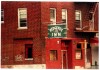
A colorful man with a black derby and Blackthorn cane, Mr. Dwyer bought the property from Lawrence Drake in 1906 and used the still surviving Seaman-Drake arch as his office and workshop.

As a contractor Dywer had an impressive career designing the Soldiers and Sailors Monument and the Metropolitan Museum of Art, but never succeeded in making over the Seaman Mansion. In fact he admitted with some embarrassment that he once chopped off the main cupola to install a swimming pool on the third floor. The pool, he said, was never used and the home was permanently disfigured.
After some discussion, Dywer invited the ladies to have a quick look inside the home.

Worden writes,” Our inspection was brief. The great halls, huge drawing-room, the library, the ancient attic and immense kitchen suggested some southern plantation. They were filled with heavy walnut and mahogany furniture. The grounds of the estate were once laid out with charming walks and shrubberyand adorned with arches and statuary brought from France. The imposing marble archway where Mr. Dwyer has his office was the entrance that led to it. Famous balls, elaborate parties and great people held forth in this now gloomy and silent house.

Over the elaborately carved mantelpiece in the dining-room of the Marble House hangs a large photograph of the estate taken thirty years ago. Mr. Dwyer is standing in the doorway. With silk hat, top coat and Van Dyke beard he presents an important figure. Then the grounds were carefully landscaped, the blue limestone walk nicely smoothed and the shrubbery neatly trimmed.
I’m afraid the clock stopped for Marble Mansion then. Today it is a ghostly figure beckoning out of the past.
The tapestried curtains veil broken drawing-room windows, wide cracks in the huge front doors, let in cold river winds, and dust covers the balustrades of the grand stairway.

Even Dywer knew the days of the old estate were numbered. Bidding the ladies goodbye he added that “he had a plan afoot to turn all of the mansion property into a new housing scheme.”


In 1938 the old Seaman Mansion was razed to make room for the new, four hundred unit housing complex, Park Terrace Gardens.
According to descendent Pierre Dywer, Thomas Dwyer moved into a rented apartment in 10 Park Terrace East to “see how the neighborhood developed.”
Thomas Dwyer died in 1943 at the age of 81. His timeworn arch remarkably still stands today.










Met you on Hall of Fame Terrace with my dog, your site is great. Jim O’Donnell
Thanks. The Hall of Fame tour was a lot of fun. All the best. Cole
Thanks for the most attractive and usually unavailable photo to date. I had lived in the neighborhood from the 1950’s through the late 1960’s. Thanks for the meories…..
Hi Cole,
Well, seeing this excerpt from “Round Manhattan’s Rim”, I’ve given up any hope I might have had of having ANY information in my “Inwood File” that you haven’t already found. What dazzling research Cole. I’ll have to check what I have, but I think the chapter I zeroxed from that book (mentioned above) does include a passage on the Isham mansion and also stopping at a diner down by the water (Broadway bridge area perhaps?). I’m sure you already have it but if not would love to share.
Just love the site and am so grateful you have the time and the energy to do all this. It is just fantastic!! A dream come true for those of us who have loved Inwood and Inwood history all these years.
Charlotte
Thanks for the fascinating history of the site of Park Terrace Gardens, where I lived from 1943-1955.
What beautiful sketches and a lovely story to accompany them. I found your post through By the City / For the City. If anyone is interested in generating momentum around revitalizing the Seaman-Drake Arch, post your comments and get people talking! Thanks for the great post! 🙂
As someone who has done the Great Saunter (more than once), I was consumed with envy for Helen Worden and her friend in “Round Manhattan’s Rim.” Clearly, eating and drinking one’s way around the periphery is preferable to walking it in a single day!
Perhaps one day I’ll make it up there and explore a bit. Thanks for the pictures.
[…] 100 x 120 foot lot, which sat across the street from the old Seaman Mansion, was purchased by Hurst in 1910. A wealthy man, Hurst made his fortune as as president of the […]
[…] designed by Albert Goldhammer, sits on the site formerly occupied by Inwood’s legendary Seaman Mansion. Today, the marble arch, which once marked the entrance to the estate, can still be seen from […]
This was my ancestor’s house. Such a shame that a beautiful landmark and building has been erased from history. Thanks for providing the insight and pictures 🙂
[…] land Herz purchased was part of the larger Seaman-Drake estate, but did not include the gleaming marble mansion just to the […]
[…] mansion in question, the old Seaman-Drake estate, was nearly a hundred years old and Fitch would soon become well versed, and possibly even […]
[…] West of the Kingsbridge Road (Broadway) and Northeast of the Isham estate, is the magnificent Seaman-Drake estate. The property contains twenty-six acres, and as formerly owned by Valentine Seaman. Its large […]
[…] to this great article from MyInwood.com, the Seaman estate was built by one John Seaman, the wealthy son of Dr. Valentine Seaman, who […]
[…] 35 foot tall, 20 foot deep marble arch was built as the gateway to a grand hilltop estate owned by the Seaman family in 1855. According to a turn of the century history of the Inwood, the […]
Dr. Valentine Seaman’s son was named John “Ferris” Seaman. His mother and Valentine Seaman’s wife was “Ann Ferris,” also the aunt of Dr. Floyd Ferris, whose family sold land with a distinctive house and other structures to William Bradley Isham in 1864. The same land was later celebrated as Isham Park in September 1912, after Julia Isham Taylor gave her portion her father’s land in Inwood to NYC for a park named in his honor.
[…] the north of these rises the stately home of Thomas Dwyer, known formerly and for many years as “Seaman’s Folly.” This has direct entrance to Broadway, and commands superb views of all the surrounding […]
[…] the north of these rises the stately home of Thomas Dwyer, known formerly and for many years as “Seaman’s Folly.” This has direct entrance to Broadway, and commands superb views of all the surrounding […]
[…] The Seaman-Drake estate is built just north of the Ferris (Isham) home. For nearly a century the huge marble home will […]
Thomas Dwyer was my great-grandfather. My grandfather Pierre grew up in that house. I do have some other photos that I can contribute to this, although I can see this page has been up for quite awhile. I’ve heard there are photos of the inside of the mansion and wouldn’t mind seeing those if anyone knows who might have them. I heard a descendant of the Seaman family has those.
Captain John seaman was a ancestor of mine. I have read some interesting stories about him. I am saddened his mansion is no longer here. It sounds like it was beautiful. Thanks for the story. Brenda heflin
Fantastic historical presentation of Seaman Mansion. My family lived at 261 Seaman from 1934 until 1990s. Great place to grow up and wonderful memories. Thank you Cole Thomson for you artistic research efforts.
[…] past. The great marble arch, constructed in the 1850’s, once led visitors to the glorious Seaman mansion, which, until the 1930’s, stood on the current site of Park Terrace Gardens on Park Terrace East […]
i lived in park terrace gardens from birth until I was 17…( 1958-1975)
I grew up playing in the back garden area, Isham and Inwood parks
My mom and dad lived there til they passed away ( 1981 & 1983)
I have ALWAYS wanted to know the story of the mansion but never did until now
Thank you so much for the history
[…] northern Manhattan would eventually see other monumental estates including the Seaman Mansion, the Billings estate and even another castle owned by the Paterno family, Libbey Castle was the […]
[…] as the races themselves. And for twelve glorious years, that social scene was based in Inwood’s Seaman mansion, which was leased by the now legendary Suburban Riding and Driving Club for use as the club’s […]